 Sunday read · The money · Through Saturday 14 November
Ramayana money check: who has been paid back so far?
Every day a new headline says Ramayana has crossed another hundred crore. Fair enough. But a ticket sold is not a rupee earned. So we asked a simpler question: of the $129.3M (₹1,228 Cr) the film took worldwide up to its second Saturday, how much has actually come back to the people who paid for it?
Two companies carry the risk on this film. Prime Focus, led by Namit Malhotra, produced it and paid to make it. Sony released it everywhere outside India and paid for that release. Everyone else, the cinemas, the tax office, the distributors, takes a cut on the way.
We have been counting Ramayana’s tickets seat by seat since presales opened, so the box office side is the part we know best. The cost side is harder. Nobody publishes a film’s accounts. What follows uses trade figures we were given this week, and we tell you at every step which numbers are solid and which are not.
Six things to know
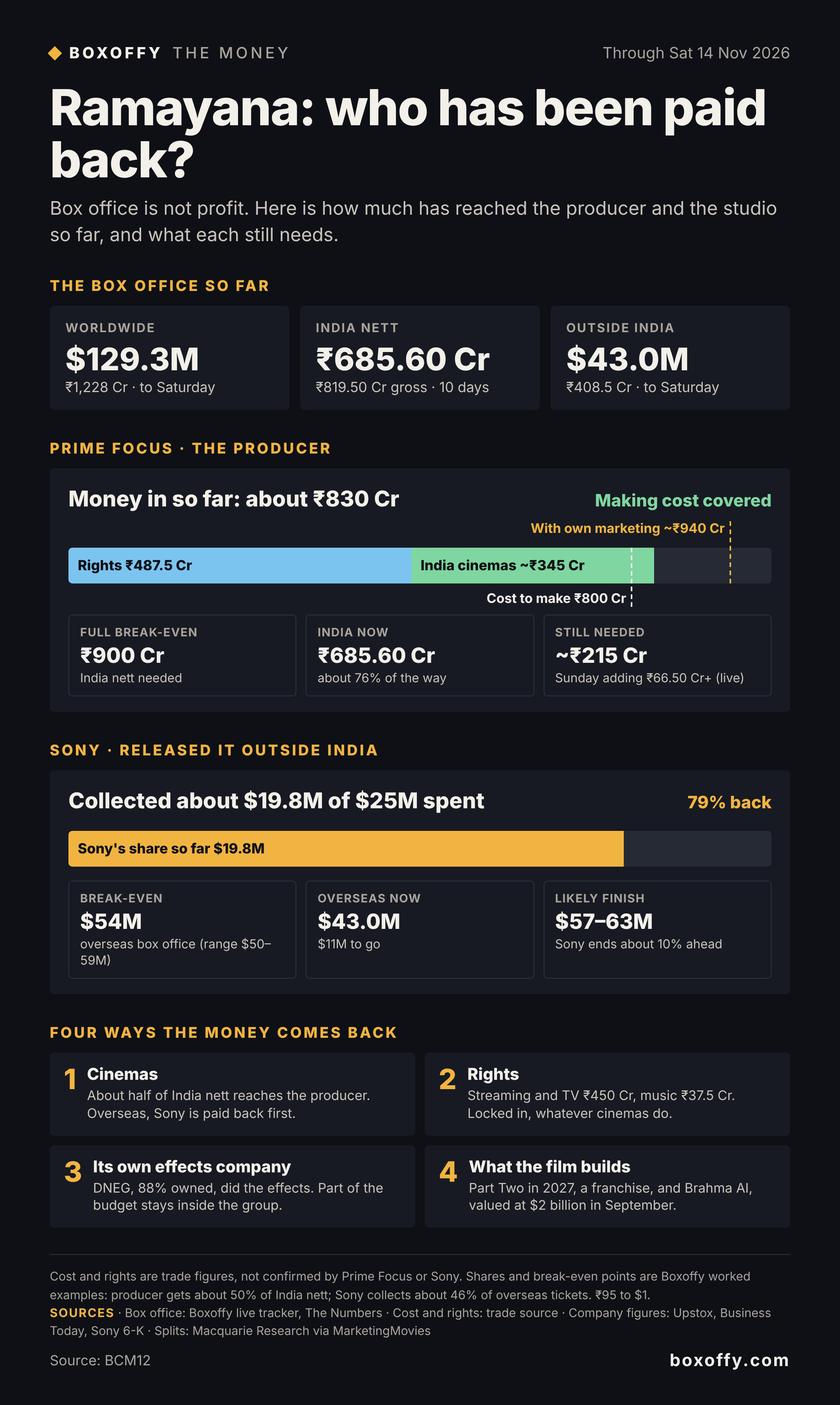
- Prime Focus has its making cost back, on trade figures. Part One is said to have cost about ₹800 Cr to make. Streaming, TV and music rights bring about ₹487.5 Cr. The producer’s share from Indian cinemas through Saturday is about ₹310–345 Cr (our estimate). Together that is about ₹800–830 Cr.
- Full break-even in India is about ₹900 Cr nett. Add the producer’s own marketing and the cost rises to about ₹940 Cr. To cover that, India needs to reach roughly ₹900 Cr nett. It stood at ₹685.60 Cr after 10 days, through Saturday, about 76% of the way.
- Sony is about 80% of the way to getting its marketing back. Sony is said to have spent about $25M releasing the film outside India. Overseas box office is $43.0M. Sony’s share of that is about $20M (our estimate).
- Sony breaks even at about $54M overseas. Our range is $50M–$59M. The run is tracking to finish at $57M–$63M, so Sony should get there, with a small profit.
- Prime Focus may earn little from overseas cinemas. If Sony is paid back first, the producer only starts earning overseas somewhere between $57M and $83M. Its money is coming from India and from rights.
- Cinemas are only one of four ways the money comes back. Rights, the group’s own effects company, and the value of what the film builds (Part Two, a franchise, an AI business valued at $2 billion) all count. We explain each below, and where the limits are.
How sure are we?
The box office numbers are solid. The cost and rights numbers come from a trade source who asked not to be named. We could not check them against a second source, and neither Prime Focus nor Sony has confirmed them. Other reports put the cost much higher (see below). Read every profit figure here as a worked example, not a company statement.
Ramayana’s money at a glance
| Question | Answer |
|---|---|
| Worldwide box office, through Saturday | $129.3M ₹1,228 Cr |
| India nett, 10 days | ₹685.60 Cr |
| Overseas box office | $43.0M |
| Cost to make Part One (trade figure) | ₹800 Cr |
| Producer’s money in so far | ₹800–830 Cr |
| India break-even | ₹900 Cr nett |
| Sony’s overseas marketing spend (reported) | $25M |
| Sony’s share collected so far | $19.8M (79%) |
| Sony break-even, overseas box office | $54M |
As of Sunday 15 November 2026, 12:30 AM US Central. Updated as new figures arrive.
The box office through Saturday 14 November
| Market | Total so far |
|---|---|
| India, nett 10 days, Thursday 5 to Saturday 14 November, industry figure. Gross ₹819.50 Cr ($86.3M). | ₹685.60 Cr |
| Outside India To Saturday 14 November, industry figure. North America $20.0M to Friday. | $43.0M ₹408.5 Cr |
| Worldwide India gross plus overseas, at ₹95 to $1. Overseas began with previews on Wednesday 4 November. | $129.3M ₹1,228 Cr |
“Gross” is what people paid at the counter. “Nett” is gross minus entertainment tax. Neither is what the producer receives. In India, cinemas keep roughly half of the nett. Outside India, cinemas and taxes keep more than half of the ticket price.
Prime Focus: making cost covered, break-even in sight
Start with the company that took the biggest bet. Prime Focus Studios produced the film, and its own visual effects company, DNEG, built the worlds you see on screen. Think of what follows as a household account: what went out, and what has come back.
| Line | Amount | Status |
|---|---|---|
| Cost to make Part One | ₹800 Cr | Trade |
| Producer’s marketing, $15M (India and worldwide) | ₹142 Cr | Reported |
| Producer’s total cost | ~₹940 Cr | Sum |
| Streaming and TV rights | ₹450 Cr | Trade |
| Music rights, Part One | ₹37.5 Cr | Trade |
| Share from Indian cinemas so far | ₹310–345 Cr | Ours |
| Money in so far | ₹800–830 Cr | Sum |
India nett ₹685.60 Cr through Saturday, of the roughly ₹900 Cr needed for full break-even: about 76%
Trade = from our trade source, unconfirmed. Reported = in the press, unconfirmed. Ours = Boxoffy estimate.
How we got the cinema share. Producers of big Hindi films usually receive 45% to 50% of the India nett. On ₹685.60 Cr that is about ₹310 Cr to ₹345 Cr. The film is released in India on a commission basis, not sold outright, so the producer keeps the upside but also pays the distributors a commission out of this share. We have not deducted that commission because the rate is not public.
Where ₹900 Cr comes from. Total cost of about ₹940 Cr, minus ₹487.5 Cr from rights, leaves about ₹455 Cr to recover from cinemas. At a 50% share, that needs about ₹900 Cr nett in India. Through Saturday the film needed roughly ₹215 Cr more. Saturday alone added ₹72.90 Cr, and by Sunday evening in India another ₹66.50 Cr had come in (live industry figure), so the gap is closing fast.
Why some reports say ₹350 Cr. Leave out marketing and music, and the sum is ₹800 Cr minus ₹450 Cr, which is ₹350 Cr from cinemas. On that narrower measure the film is already there. We use the wider measure because marketing is real money spent.
The cost is disputed
Earlier reports put Part One at ₹1,400–1,500 Cr to make and release. That figure appears to include Sony’s $25M of overseas marketing, which is Sony’s money, not the producer’s. Even so, the gap with the ₹800 Cr trade figure is large. If the higher number is right, India would need well over ₹1,500 Cr nett for the producer to break even on Part One alone.
A note on the visual effects. The effects were made in-house by DNEG, which Prime Focus owns. That does not make them free: artists still have to be paid. What the producer saves is the profit margin an outside effects company would charge, put at 15% to 20% by our source.
And Part Two. Both films were shot together, and rights for Part Two are yet to be counted. Our source says anything left unrecovered on Part One would be settled against Part Two. That is normal for a two-part film, but it also means the final answer on profit will only come in 2027.
Sony: about 80% of its marketing back
Sony’s deal is unusual. It released Ramayana in every country outside India but, according to reports, paid nothing up front for the rights. Instead it put its own money, about $25M, into marketing the film abroad, and it earns that back from ticket sales. Our source adds one detail: all of the overseas marketing is Sony’s. Prime Focus is not putting money into the overseas release.
| Step | Low | Middle | High |
|---|---|---|---|
| Overseas box office so far | $43.0M | $43.0M | $43.0M |
| Share Sony collects from cinemas | 42.5% | 46% | 50% |
| Collected so far | $18.3M | $19.8M | $21.5M |
| Against $25M spent | 73% | 79% | 86% |
| Overseas box office needed to break even | $59M | $54M | $50M |
Sony has collected about $19.8M of the $25M it spent: about 79% (middle case)
Studios collect about half of ticket sales in North America and about 40% elsewhere. Ramayana earns nearly half its overseas money in North America, so the blended share is around 46%.
What Sony makes if the run ends where we expect. Past Hindi hits added 25% to 29% to their overseas total after the second weekend. That points to a finish of $57M–$63M. At $60M, Sony would collect about $27.6M against $25M spent: a gain of about $2.6M, or roughly 10%. After that, Sony also earns a distribution fee, which is not public.
For a studio whose film division made ¥92.6 billion in operating profit in the July–September quarter, this is small change. What Sony really gets is proof: an Indian film can be released like a Hollywood one, in more than 1,400 North American theatres at once, and find its audience.
Why overseas may pay the producer little
In deals like this, the studio usually takes back its marketing spend and its fee before the producer sees any money. On our worked example, Prime Focus earns its first overseas dollar somewhere between $57M and $83M, depending on the terms. The run is tracking to $57M–$63M.
So one of the biggest overseas runs ever for a Hindi film may send little or nothing back to the producer from cinemas. What it does buy is reach: a worldwide audience for Part Two, and a stronger hand when selling rights.
One correction to our earlier work. We had treated the producers’ $15M of marketing as extra overseas spend to recover. Our source says that money covers India as well, and that the producer spends nothing overseas. If so, the producer has no separate overseas marketing bill to earn back.
A budget on paper and a budget in cash
Here is something the “most expensive Indian film ever” headlines miss. Imagine a builder who owns the cement factory. The house may be valued at ₹1 crore, but the builder did not pay retail for the cement.
Film budgets work the same way. When a company makes a film using its own subsidiaries, the budget you read about is partly a pro forma number: a budget written as if every service had been bought from outside at full price.
Ramayana is the clearest case in Indian cinema. Prime Focus owns 88.2% of DNEG, the company that made the visual effects. So a large part of the “budget” is one part of the group paying another.
- What stays real. Artists, computers and studios cost real money. In-house does not mean free.
- What stays inside. The profit margin an outside effects company would charge, put at 15% to 20% by our source, never leaves the group. So the cash the group actually spent is lower than the headline budget.
- What DNEG gains. For DNEG, Ramayana is paid work. It kept its teams working, and the film is now a showreel for winning other contracts.
A simple example, not the film’s real split
Suppose ₹400 Cr of an ₹800 Cr budget is effects work billed by DNEG at market price. With a 15–20% margin, ₹60–80 Cr of that is profit that stays in the group. On paper the film cost ₹800 Cr. In cash, the group spent about ₹720–740 Cr. The real effects share of Ramayana’s budget has not been published.
Part One also pays for Part Two. Both films were shot together. Sets, digital characters and worlds built for Part One are used again. And every rupee spent making Part One famous is also marketing for Part Two, due at Diwali 2027. A fair account would move part of Part One’s cost to Part Two. How the producer splits it is not public.
Judge it like a start-up, not only like a film
Nobody asks whether a young technology company made a profit in its first year. They ask what it has built and what that could earn later. There is a case for looking at Ramayana the same way. Producer Namit Malhotra has said plainly that this is how he sees Ramayana: “a universe”, not two films. On that view, the return has four parts.
| Where value comes from | What we know |
|---|---|
| 1. Cinemas | ₹685.60 Cr India nett and $43.0M overseas through Saturday. Covered above. |
| 2. Rights | ₹487.5 Cr for Part One on trade figures. In April, reports said the producer turned down ₹700 Cr for streaming rights to both films and wanted about ₹1,000 Cr. |
| 3. The group’s businesses | DNEG is valued at about $2.5 billion. Brahma AI, whose lip-sync technology dubbed the film into dozens of languages, raised $150M at a $2 billion valuation in September. Prime Focus keeps about 66% of it. |
| 4. The franchise | Part Two in 2027. The producer has shown plans for games, merchandise, spin-off films and series, theme park attractions and a stage musical. None has a signed partner or a number yet. |
Why this matters. When Disney bought Marvel in 2009 and Lucasfilm in 2012, it paid about $4 billion for each. Disney told its shareholders in 2024 that Marvel had returned 3.3 times that and Lucasfilm 2.9 times. That return came over many years, from sequels, licensing and parks, not from one film.
The stock market is already pricing some of this. Prime Focus was worth about ₹23,000 Cr in July, after its shares roughly doubled in a year. That is far more than any single film could earn.
Where the start-up comparison stops
A valuation is a promise, not cash. Three cautions:
- Debt is real. Prime Focus had gross debt of ₹5,062 Cr in March 2026 and pays over ₹500 Cr a year in finance costs. Interest is paid in cash, not in valuation.
- The Ramayana is not owned by anyone. The story belongs to everybody. Prime Focus owns its version: these designs, these characters as filmed, this music. Marvel and Star Wars are owned outright. That limits how far the comparison goes.
- Plans are not contracts. Games and parks count only when a partner signs and pays.
This article is analysis, not investment advice.
Five open questions
- The real cost. ₹800 Cr and ₹1,400–1,500 Cr cannot both be right. Prime Focus has not published a figure for Part One alone.
- Sony’s fee and the order of payment. Not disclosed anywhere we could find.
- The India commission rate. It comes out of the producer’s share and would push break-even above ₹900 Cr.
- How rights are split between the two parts. The ₹450 Cr streaming and TV figure may cover Part One only, or both.
- China and Japan. No release date yet. A release there would change the overseas sums.
We will update this page when official numbers arrive, and we will say plainly where our worked example turned out wrong. If you work on the film and can correct a figure, write to us on X at @BoxoffyMI.
Ramayana budget and profit: quick answers
Has Ramayana recovered its budget?
On trade figures, yes for the cost of making it. Part One is said to have cost about ₹800 Cr to make. Rights bring about ₹487.5 Cr and the producer's share from Indian cinemas is about ₹310–345 Cr through Saturday 14 November, which together is about ₹800–830 Cr. With the producer's own marketing the cost is about ₹940 Cr, which is not yet covered. These figures are not confirmed by Prime Focus.
What is Ramayana's break-even at the India box office?
About ₹900 Cr India nett, on Boxoffy's worked example. The producer's total cost of about ₹940 Cr, less ₹487.5 Cr from streaming, TV and music rights, leaves about ₹455 Cr to recover from cinemas. At a 50% share of nett that needs about ₹900 Cr. The film stood at ₹685.60 Cr nett after 10 days, through Saturday 14 November.
Has Sony made its money back on Ramayana?
Not yet, but it is close. Sony is reported to have spent about $25M on marketing outside India. Overseas box office is $43.0M, and Sony's share of that is about $19.8M, or roughly 79% of its spend. Sony breaks even when overseas box office reaches about $54M (range $50–59M).
How much did Sony pay for Ramayana's overseas rights?
According to reports, nothing up front. Sony releases the film in every market outside India, pays for overseas marketing, and is paid back from ticket sales before the producer. Neither Sony nor Prime Focus has confirmed the terms.
What is a pro forma budget in film?
It is a budget written as if every service were bought from outside at full price. When a producer owns the companies doing the work, as Prime Focus owns the effects company DNEG, part of that budget is one arm of the group paying another. The real costs, such as artists' salaries, remain. The profit margin, about 15–20% on effects work, stays inside the group, so the cash spent is lower than the headline budget.
Will Prime Focus make money from Ramayana's overseas box office?
Possibly very little from cinemas. If Sony recovers its marketing and fee first, Prime Focus starts earning overseas only when the run passes somewhere between $57M and $83M. The run is tracking to finish at $57–63M. The producer's return comes mainly from India, from rights, and from the value of Part Two and the wider franchise.