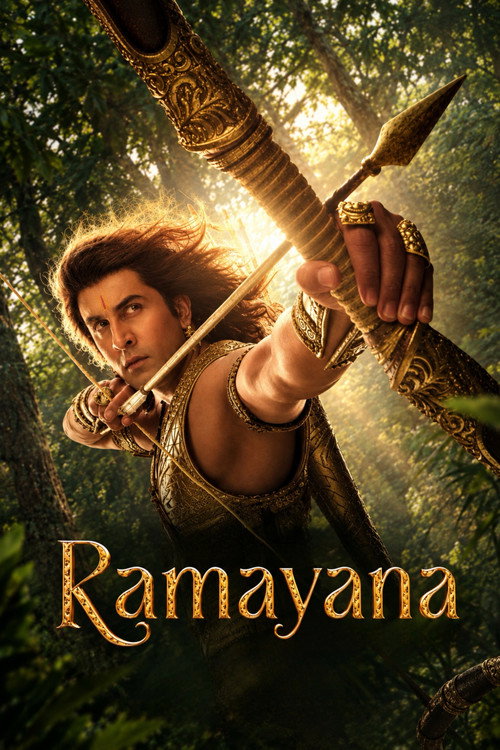
The story India never had to invent
Tolkien spent a lifetime building England a mythology because he believed it had lost its own. India has had one in daily use for two thousand years — and has never once put it on a screen at that size. Why Ramayana working matters, and why that has almost nothing to do with the box office.
The film, in brief
- Film: Ramayana: Part 1
- Director: Nitesh Tiwari
- Release: 5 November 2026, with Part 2 to follow in 2027
- Diwali 2026: Sunday 8 November - inside the film's opening weekend
- Cast: Ranbir Kapoor as Ram, Sai Pallavi as Sita, Yash as Ravana, Sunny Deol as Hanuman, Arun Govil as Dasharatha
- Music: A.R. Rahman and Hans Zimmer, their first collaboration
- Made by: Namit Malhotra, Prime Focus Studios with DNEG and Monster Mind Creations; Sony Pictures handling global distribution
- Investment: Around Rs 4,000 crore across BOTH parts, including visual effects, global distribution and international marketing - the largest sum ever committed to an Indian production
In the 1930s an Oxford professor set himself a strange task.
J.R.R. Tolkien believed England had mislaid its own mythology. The Norse had theirs. The Greeks had theirs. The English had fragments. So he decided to build one from scratch.
It took him most of his life. He invented the languages first, then the maps, then family trees going back thousands of years, and only then the story that sat on top of all of it.
It found readers slowly. And then, nearly fifty years after he began, three films shot in New Zealand turned one man's private invention into the shared property of the planet.
Today a schoolchild in Pune knows what a hobbit is.
A mythology somebody made up became global common knowledge, because someone finally filmed it properly.
India never had to invent anything.
The Ramayana has been in continuous use for more than two thousand years. Recited, sung, performed in village squares, rewritten in every language of the subcontinent, argued about ferociously, and never once set aside. None of it sits in a library. It is in the calendar, in people's names, in the way Indians speak when they are not thinking about it.
And it has never been put on a screen at the scale Tolkien's invention got.
The gap was never in the material. The gap was in the telling.
Start with the word everyone uses and nobody explains
You cannot talk about the Ramayana honestly without dharma. And dharma gets mistranslated as "religion" almost every time, which throws the whole thing off before it starts.
The closest everyday meaning is this: the right thing to do from where you happen to be standing.
It is attached to your position, not your preference. A son has one dharma. A king has another. A brother, a soldier, a wife — each has their own. It shifts depending on where you stand, which is why it is difficult and why the epics run so long. They are thousands of pages of worked examples rather than a rule book.
The Ramayana sets this up in its first few moves, and it does it brutally.
A king has promised his queen two wishes, years ago, carelessly. She comes to collect. She asks for her own son on the throne — and for Ram, the heir, the one the city is already garlanding, to be sent into the forest for fourteen years.
The promise was foolish. The demand is cruel. Honouring it kills the old man.
He honours it anyway, because a king's word is the only currency a kingdom runs on.
- Ram goes. He does not argue, does not bargain, does not raise the army he could easily have raised. The crown had been his that morning.
- Lakshman goes with him, having been asked to do nothing of the kind.
- Sita goes with him, and has to fight to be allowed to.
Bharat, the one who gains everything, refuses it. He walks to the forest, begs his brother to come home, is refused, and returns carrying Ram's sandals. He puts them on the throne and rules fourteen years as a caretaker. Never as king.
Every one of them takes the expensive option. Not because a god commanded it. Not because a punishment was waiting. Because of who they are and what was promised.
That is dharma.
And it is why the story has lasted: an enormously long, enormously detailed answer to a question that turns up in every generation and every life: what do I do when the right thing is going to cost me everything?
The line you do not cross
Ravana is the most misread figure in Indian storytelling.
He is no monster, and the text never says he is. He is a scholar. A superb king; Lanka under him is golden. A musician. A devotee of Shiva so complete that Shiva himself grants him his boons.
The ten heads are a picture of how much the man knows, not a deformity.
He is destroyed for exactly one thing. He takes a woman who is not his, and he will not give her back.
The story is surgical about this. He is not brought down for being powerful, or dark, or foreign, or clever, or for worshipping the way he worships. He is brought down for crossing one line and then refusing every chance to step back over it. His own brother tells him to return her, and is exiled for saying so. His wife tells him. He refuses — and that refusal, not his strength and not his learning, is what ends him.
This is why Indians still speak in these terms without noticing.
Lakshman rekha, a line drawn to keep someone safe which you cross at your own cost, turns up in Indian courtrooms, newspaper headlines and family kitchens, used fluently by people who could not tell you which chapter it comes from.
The vocabulary outlived the reading, which is what a living story looks like.
The brother who walked out
Ravana has a younger brother, and the Ramayana hands him one of the hardest jobs in the story.
Vibhishana says the obvious thing out loud. Return her. This is wrong, and it will destroy us. He says it in open court, to a brother who is also his king and the most powerful being alive.
For that he is humiliated and thrown out.
So he does the thing the story knows you will flinch at. He walks across to the other side, to the army besieging his own city, and asks to be taken in.
Think about what that costs him. He is abandoning his brother, his king, his kingdom and his own people, in the middle of a war, for the sake of a woman from another country he has never met. By every ordinary measure of loyalty, Vibhishana is a traitor.
The epic disagrees, and says why.
Loyalty to a brother who is in the wrong is not loyalty. It is complicity.
Dharma sits above blood. The moment it does not, every promise in the story becomes negotiable.
The Ramayana refuses to make that easy on itself. Their other brother, Kumbhakarna, also tells Ravana to his face that he is wrong — and then goes out and fights for him anyway, and dies for him. The story lets him be magnificent while he does it. You can make the other choice and still be honourable. You cannot make it and survive what is coming.
On the far side of the field, Ram's own allies tell him Vibhishana is obviously a spy; look where he has just come from. Ram takes him in anyway, on a principle the story states plainly: someone who comes to you for refuge is given refuge. You do not audit a man's family before you shelter him.
And when the war is over and won, Ram does not keep Lanka.
He crowns Vibhishana king of it, and goes home.
The hero of India's oldest epic fights a war on foreign soil, wins it completely, and annexes nothing.
It is the entire theory of power in a single move. Bharat refuses a throne he could have taken. Vibhishana is handed one he never asked for. Ram walks away from one he could have kept.
In this story, the people fit to hold power are consistently the ones least interested in holding it.
The one who wanted nothing at all
Then there is Hanuman, the most present figure in everyday Indian life and the hardest to explain to anyone who did not grow up with him.
You find him at the edge of a field, under a tree at a bus stand, in a niche at the back of a workshop. He has more small shrines than anybody, and the Hanuman Chalisa is probably the most recited text in the country — in gyms, in traffic, before exams, by people who would never describe themselves as religious.
Why him?
Because Hanuman is bhakti, devotion, and the Ramayana shows devotion as something you do, not something you feel.
Hanuman does not pray at Ram. He works for him. He crosses an ocean. He finds Sita when nobody else can. Sent to fetch one healing herb and unable to tell which of them it is, he picks up the entire mountain and carries it back. He is funny, enormously strong, and completely without side.
And he asks for nothing. No kingdom, no title, no share of anything. At the end of the greatest war in the story, the most valuable person in it wants no part of the settlement.
Hanuman has all of that power from the very beginning, and he does not know it. He has forgotten. Before the leap to Lanka, somebody has to stand in front of him and remind him what he is capable of. Only then does he do it.
A child hears that and understands it instantly, and so does an adult. The strength was never the problem. Knowing it was there was.
That is why there is a Hanuman at the bus stand. He is not there to be admired. He is there because the story says: show up, do the work properly, want nothing for it — and you will turn out to be far stronger than you thought.
Ram Rajya is not nostalgia. It is a standard.
The phrase gets used a great deal and understood a little. It is not a longing for a lost golden age.
What people mean by it is specific.
Nobody goes hungry. The weakest person in the kingdom can get a hearing from the most powerful one. Whoever holds authority is bound by the same rules as everybody else, and knows it.
Gandhi used the phrase constantly to describe the India he hoped for, and what he meant by it was quite practical: a society where power answers for itself.
So it is a yardstick. And the remarkable thing is that it is still in working order. Two thousand years on, a civilisation that has changed nearly everything else about itself has not changed what it thinks good looks like. That kind of continuity is rare. Most cultures have swapped out their measuring stick several times over.
Now the honest part
India does not look like Ram Rajya, and it would insult anyone's intelligence to pretend otherwise.
There is hardship that should not exist in a country holding this much wealth. There are old divisions that have not gone away. There is a daily distance between how things are supposed to work and how they actually do, and every Indian can describe it from experience rather than theory.
The standard existing is not the same as the standard being met. Anyone selling you that equation is selling you something.
But look at what the gap is made of.
Almost every argument India has with itself is an argument about that distance. Whatever the subject, the complaint tends to arrive in the same shape:
People were supposed to be fed. The weakest one was supposed to be heard. The same rules were supposed to apply to everybody.
Different sides, different conclusions — and the same measuring stick in everybody's hand.
A people who have lost their standard argue about nothing. A people who still have one argue furiously about how far short they are falling.
India does the second thing, loudly, every day, in a few hundred languages.
That is not evidence the fabric has gone. That is the fabric.
This is consciousness, not belief
Nobody in India sits down to study the Ramayana. You absorb it, usually well before you can read.
Two of the country's largest festivals are literally its plot. Dussehra is the day Ravana falls — effigies burn in a few thousand towns on the same evening. Diwali, twenty days later, is the night Ram comes home.
A child lights those lamps for ten years before anybody gets around to explaining why.
When UNESCO added Ramlila, the open-air performances staged across north India every autumn, to its heritage list in 2008, the thing it singled out was that the plays bring the whole population together "without distinction of caste, religion or age."
Villagers build the masks and the effigies. The audience sings along with the narration. Nobody is checking what you believe at the edge of the field.
Most arguments about this film will miss that distinction.
Belief is something you sign up to. Consciousness is something you are already standing in before anyone asks you.
An Indian atheist will still say Lakshman rekha and mean a line that must not be crossed. Muslim families in Benares have made Ramlila costumes for generations. The story operates underneath the level of argument — which is why it has outlasted every empire that came through.
It has never stopped being rewritten either.
Tulsidas put it into the people's language in the sixteenth century. Kamban wrote it in Tamil. There are versions where Sita is the centre of gravity, versions where Ravana is treated with real sympathy, versions that flatly contradict each other on what happened and what it meant. Scholars count them in the hundreds.
None of that is a weakness. A text that every region rewrote in its own tongue, and kept arguing about for a thousand years, is a living thing rather than a fixed one.
The arguing is the proof of life.
It was India's first export, long before anyone said "soft power"
The Ramayana left home more than a thousand years ago, and it never came back.
Thailand's national epic is the Ramakien. Thai kings are titled Rama. The old capital was Ayutthaya — which is Ayodhya.
Java has had its own Ramayana in verse for over a millennium. Cambodia has the Reamker. Laos, Myanmar and the Malay world each have their own.
Indonesia, the largest Muslim-majority country on earth, still dances the Ramayana at Prambanan on summer nights, for audiences who do not regard it as a religious act at all.
Nobody was running a cultural ministry when any of that happened. There was no budget line and no strategy document. The story travelled because it was good, and because it answered something people recognised in themselves.
So this film is not a debut. It is a homecoming with better equipment.
The part most epics don't have: coming home
Most epics end at the victory. The enemy falls, the hero stands over him, and that is the last page.
The Ramayana does not stop there. It has one more movement, and that movement, not the war, is the one the country celebrates.
Ravana has fallen. Lanka has been handed back to Vibhishana. And there is still the matter of getting home. The fourteen years are nearly up. In Ayodhya, Bharat is still ruling with his brother's sandals on the throne, and he has said plainly what he will do if Ram is not back on the appointed day. Hanuman is sent ahead with four words: he is coming home.
And the city lights every lamp it owns.
Not for a conqueror. Nobody in Ayodhya is celebrating a war. They are lighting a path so that a family walking back in the dark can find the door.
That is Diwali. The largest festival in the country, in hundreds of millions of homes, and what it marks is the arrival rather than the battle.
The story sits inside the calendar. Dussehra is the day Ravana falls. Diwali is twenty days later. The gap between the two festivals is the journey. A civilisation took the travel time of a story and built it into its year.
And of everything it could have chosen to mark, India chose the return.
Any Indian family can tell you why. Somebody is always away. A son in the Gulf. A daughter in Bengaluru. A father on a site he will not describe properly on the phone. A child in a hostel three states over. India is, and has always been, a country organised around people who went somewhere else to work — and the light left on for them.
Diwali is also the week the trains and the planes fill up. The festival and the migration are the same event. Half the country is travelling home in order to light lamps about somebody travelling home.
The fourteen years matter here too. Exile in this story is not only a punishment to be served. It is the price of a promise, kept by everyone at once. And what waits at the end of it is not a throne, but an open door.
It is a quietly enormous idea to hand a child. You can be sent away. You can lose everything. You can be gone a very long time. And home is still there, and it has been keeping a light on.
Which makes the timing of this film almost too neat to have been designed.
Ramayana opens on 5 November. Diwali night falls on Sunday 8 November — inside its first weekend. The film about coming home reaches cinemas in the same week the country lights its lamps for exactly that.
And for the more than thirty million Indians who live somewhere else, that weekend is the one night a year when the distance is impossible to ignore. A great many of them will watch this in Dallas, in New Jersey, in Melbourne, in Leicester.
We will be counting those seats, one at a time.
Why it has to work, and it isn't about the money
Over two decades, deliberately and with state backing, Korea decided that its culture would be an export.
It worked so completely that a teenager in Lucknow now knows Korean words and a grandmother in Chennai has opinions about a Seoul drama.
Nobody calls that nationalism. They call it good.
India exports engineers, doctors, food and yoga. It exports its people, in enormous numbers, to every country that will have them. What it does not export is its story — not at scale, not on purpose. The world's picture of India is assembled almost entirely from other people's footage.
If this film works, two things follow, and neither is financial.
A generation that meets everything through a screen gets to meet this one properly: in its own language, at the size it has always deserved, instead of through a half-remembered television serial or a grandparent's summary.
And the rest of the world gets offered the thing itself, rather than a postcard of it.
If it does not work, the lesson Indian studios will take away is simple, and wrong: do not spend on your own roots. And we go back to importing other people's gods and exporting none of our own.
That is the stake. Not whether a producer recovers his investment, but whether the most expensive argument India has ever made for its own story lands.
And no, this isn't jingoism
Jingoism says mine is better than yours.
This says mine is worth telling at the same size as yours.
Nobody called The Lord of the Rings English chauvinism. Nobody calls BTS Korean nationalism. Nobody seriously thinks a Marvel film is American propaganda — though it sits a great deal closer to one than this does.
A story that has survived two thousand years, crossed a dozen borders without an army, been rewritten in fifty languages, and is still performed every autumn by villagers who do not all share a religion does not need defending by anybody.
It needs telling. Well, at full size, and in front of everyone.
On 5 November we find out whether it got that.
Everything above is an argument. The rest of what we do is not. Boxoffy is counting Ramayana's presales seat by seat across every market where the seat maps can be read — the United States, Canada, the UK, Australia, New Zealand, Germany, the Netherlands, Sweden and India — and publishing what is counted, what is held back, and what we cannot see.
Live tracker → boxoffy.com/ramayana
Notes: UNESCO inscribed Ramlila on the Representative List of the Intangible Cultural Heritage of Humanity in 2008. Dating of the Valmiki Ramayana is debated; "more than two thousand years" is the conservative end of the scholarly range for the core text. This piece is an essay and is labelled as one — Boxoffy's presale reporting is counted data and is published separately.
Questions people ask about the Ramayana
What is the Ramayana?
The Ramayana is one of India's two great epics, composed in Sanskrit by Valmiki and in continuous use for more than two thousand years. It tells the story of Ram, heir to the kingdom of Ayodhya, who accepts fourteen years of exile to honour his father's promise; of his wife Sita, who is abducted by Ravana, the king of Lanka; and of the war fought to bring her back. It has been retold in every language of the subcontinent and in several countries beyond it.
What does dharma actually mean?
The closest everyday meaning is the right thing to do from where you happen to be standing. Dharma is attached to your position rather than your preference - a son, a king, a brother and a soldier each carry a different one. It is not a list of commandments, which is why the epics are long: they are thousands of pages of worked examples rather than a rule book.
What is Ram Rajya?
Ram Rajya describes the rule of Ram in Ayodhya, and in ordinary Indian usage it means a standard for how authority should behave: nobody goes hungry, the weakest person can get a hearing from the most powerful one, and whoever holds power is bound by the same rules as everybody else. Gandhi used the phrase frequently to describe the India he hoped for. It functions as a yardstick rather than a historical claim.
Why is Diwali connected to the Ramayana?
Diwali marks the night Ram, Sita and Lakshman return to Ayodhya after fourteen years of exile. The city lit every lamp it had so the returning family could find its way home in the dark, and the festival repeats that act. Dussehra, twenty days earlier, marks the day Ravana falls - so the gap between the two festivals is the journey home.
Who was Vibhishana and why did he leave Ravana?
Vibhishana was Ravana's younger brother. He told Ravana openly that abducting Sita was wrong and that it would destroy Lanka, was humiliated and expelled for saying so, and then crossed over to Ram's side. The epic treats this as dharma rather than betrayal, on the reasoning that loyalty to a brother who is in the wrong is complicity. After the war Ram crowned him king of Lanka and returned to Ayodhya, keeping no territory.
Why is Hanuman so widely worshipped in India?
Hanuman represents bhakti - devotion - expressed as service rather than ritual. He crosses an ocean to find Sita, carries an entire mountain when he cannot identify the single healing herb he was sent for, and asks for nothing at the end of the war. He also has to be reminded of his own strength before he can use it, which is the detail most people remember. Small Hanuman shrines are found at roadsides, bus stands and workplaces across India, and the Hanuman Chalisa is among the most recited texts in the country.
Is the Ramayana only a Hindu religious text?
It is a sacred text in Hinduism, but it also functions as shared cultural knowledge well beyond religious practice. UNESCO inscribed Ramlila - the open-air performances staged across north India each autumn - on its heritage list in 2008, noting that the plays bring communities together without distinction of caste, religion or age. Versions of the story are national literature in Thailand, Cambodia, Laos, Myanmar, Malaysia and Indonesia, where it is performed as culture rather than worship.
Has the Ramayana been told outside India?
Extensively, and for more than a thousand years. Thailand's national epic is the Ramakien and Thai kings carry the title Rama; the old Thai capital Ayutthaya is named after Ayodhya. Java has had its own Ramayana in verse for over a millennium, Cambodia has the Reamker, and Indonesia - the largest Muslim-majority country in the world - still performs the Ramayana as dance at Prambanan.
When does the Ramayana movie release?
Ramayana: Part 1, directed by Nitesh Tiwari, releases in cinemas on 5 November 2026. Part 2 is expected in 2027. Diwali 2026 falls on Sunday 8 November, inside the first film's opening weekend.
The measurable part
Everything above is an argument. The rest of this site is not. Boxoffy is counting Ramayana's presales seat by seat across every market where the seat maps can be read — the United States, Canada, the United Kingdom, Australia, New Zealand, Germany, the Netherlands, Sweden and India — and publishing what is counted, what is held back, and what we cannot see.