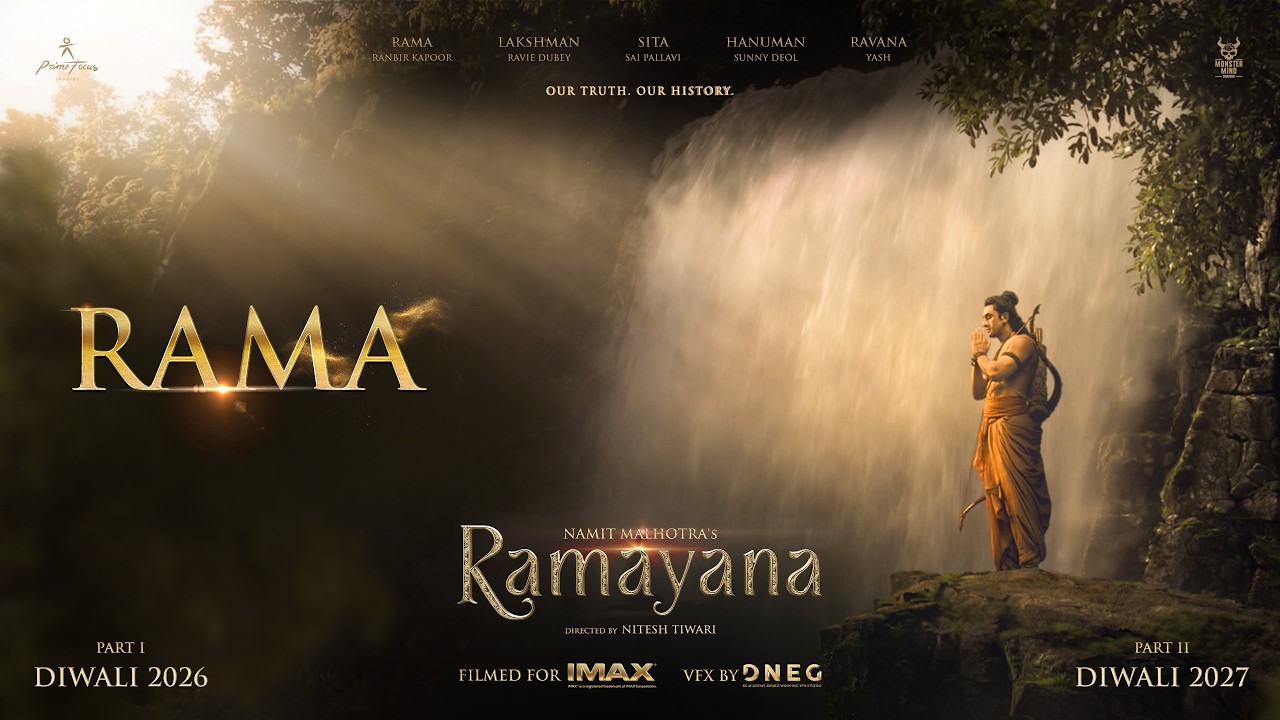
On Hanuman Jayanti — the timing deliberate, the symbolism impossible to miss — Prime Focus Studios dropped the Rama teaser for Nitesh Tiwari's Ramayana: Part 1. Two minutes and thirty-eight seconds. No dialogue. Ranbir Kapoor, sitting on a boat, slowly turning toward the camera. It is a quiet, studied reveal for one of the most anticipated films in Indian cinema history.
The opening moment has been widely described as visually poetic and emotionally restrained — and that is precisely the right instinct for this character. Rama is not meant to storm into a frame. He arrives.
▶ Watch on YouTube · Official teaser · Released Apr 2, 2026 · Hanuman Jayanti · 2 min 38 sec
The most debated element before the teaser was the music. AR Rahman and Hans Zimmer collaborating on the same score is the kind of pairing that sets expectations impossibly high — and invites just as much noise when anything short of perfection lands.
The criticism online about the score being "underwhelming" deserves a rebuttal. What ARR composed here is not a blockbuster crescendo — it is something more considered. The score builds weight without demanding attention, which is exactly what the character of Rama requires. Zimmer's orchestral sweep underneath Rahman's vocal textures creates an atmosphere that feels ancient and cinematic at the same time. Is it ARR's most spectacular work? No. Is it right for this film? Yes. The distinction matters.
Ranbir Kapoor's first look as Lord Ram has broadly landed well — and the critics who expected something more dramatic may have misread the assignment. Rama is dignity and restraint made flesh. Ranbir's calm, unhurried body language in the teaser is not a lack of intensity — it is precisely calibrated. Ranbir said himself: "I am here not to represent Rama, but to learn from him."
That said, a teaser with no dialogue can only take the look so far. The real test will be the dialogue promos — when Ranbir has to hold a line from Valmiki under the weight of a billion people's expectations. That is where the performance will truly be judged, and where this reviewer is withholding full verdict until then.
The one genuinely valid critique is the CGI in the teaser's early sequences. Some shots — particularly the demon army and the opening wide landscapes — look unfinished. X reactions called it "Unreal Engine on free trial" and made the inevitable comparison to Adipurush, which became a benchmark for how badly mythological VFX can go wrong in Indian cinema.
The comparison is premature. Adipurush's VFX was widely criticised after release. Ramayana still has six months of post-production. The VFX house here is DNEG — eight-time Academy Award winners, responsible for Dune, Interstellar and Inception. The gap between a teaser and a finished film in VFX-heavy productions is routinely significant. Concern is fair. Panic is not.
The most underrated reason for confidence in Ramayana is the director. Nitesh Tiwari made Dangal — the highest-grossing Indian film of all time — not because of spectacle, but because of emotional precision. He made Chhichhore, which won the National Award and genuinely moved audiences. His instinct is for the human inside the epic, not the epic for its own sake.
Ramayana's greatness as a text is not its battles. It is its choices — duty over desire, sacrifice over self. If Tiwari brings to Rama what he brought to Mahavir Singh Phogat, the VFX will be secondary to what the film makes you feel. That belief is the strongest argument for this film, and no teaser can diminish it.
| Director | Nitesh Tiwari |
| Music | AR Rahman & Hans Zimmer |
| VFX | DNEG (8× Oscar winners) |
| Producer | Namit Malhotra · Prime Focus Studios |
| Budget | ~₹4,000 Cr (both parts) · ~$500M |
| Release | Diwali 2026 (Part 1) · Diwali 2027 (Part 2) |
| Format | IMAX · Worldwide |