It Moved Off Diwali. That One Change Rewrites The Whole Opening.
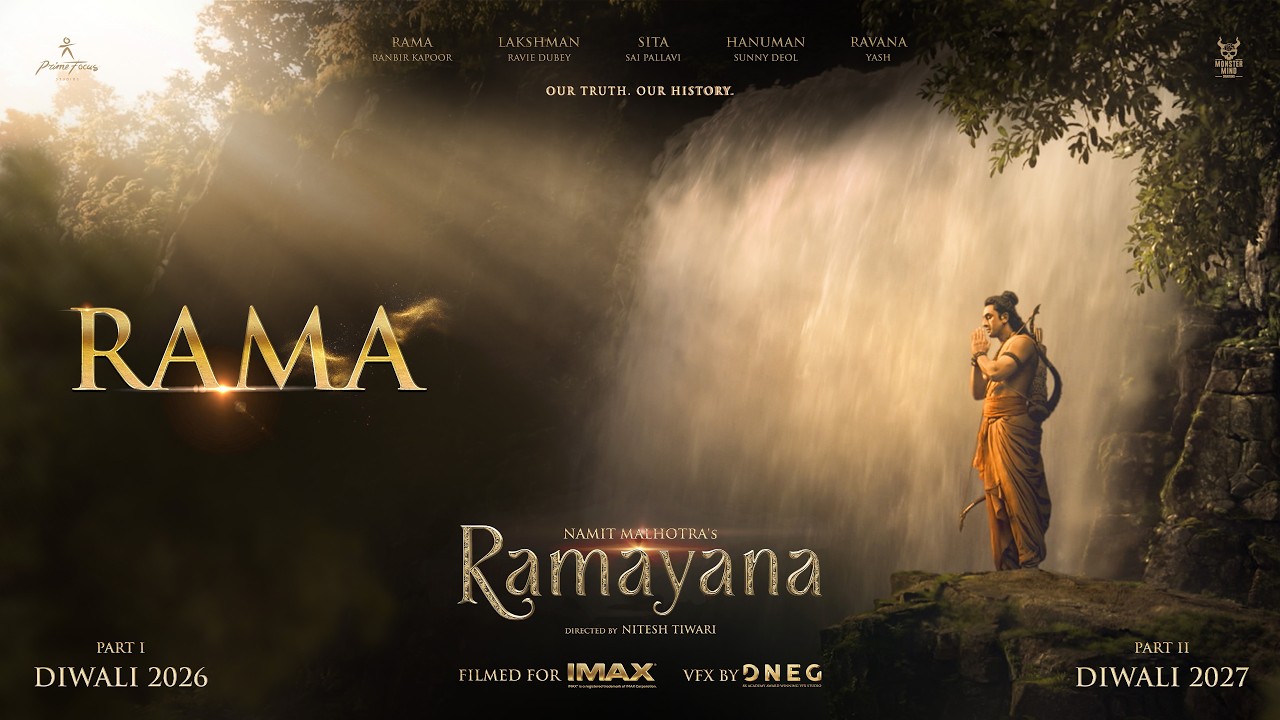
In March we modelled Ramayana opening on Diwali itself and declining from there. It now opens Thursday 5 November — three days before Diwali. The curve inverts: a smaller first day, and a four-day weekend that climbs into the biggest holiday of the year. Here is the revised model, what Sony taking North America directly actually means, and the 59,000-screen figure everybody is quoting that nobody has sourced.
Title confirmed 28 September as Ramayana: Rise of a Legend. Sony's own announcement that day said 6 November; the makers' announcement on 11 October says 5 November. Both are live in the record and we flag it rather than pick quietly — see the method note at the end.
What actually changed since 1 April
| Then (our Part 1, 30 March) | Now |
|---|---|
| Release 8 November, Diwali day | 5 November, Thursday — Diwali falls on day four |
| Title: Ramayana: Part 1 | Ramayana: Rise of a Legend |
| No trailer | Trailer 18 Jul (Bharat Mandapam), Comic-Con 23 Jul, digital 30 Jul; English cut 5 Aug |
| No songs | “Jai Jai Ram” on 14 Sep — Shreya Ghoshal and Arijit Singh, Rahman |
| Sony “international distribution”, North America unconfirmed | Sony Pictures Releasing handles North America directly |
| IMAX only | IMAX 3D, Premium Large Format, plus ScreenX and 4DX |
| India distributor unknown | Dharma took Hindi theatrical, reported around ₹250 Cr |
| — | T-Series took music rights for both parts, reported around ₹75 Cr |
| — | MrBeast at the Mumbai pre-release event, 26 Sep |
The date move is the whole story
Almost every forecast in circulation still treats this as a Diwali release. It is not. It opens on a working Thursday, and Diwali lands on Sunday 8 November — day four.
That matters more than it sounds, because our entire Part 1 argument was about who turns up. We said a U/A certificate lets families into B and C centres that an adults-only film cannot reach, and that this is where the footfall comes from. That argument still holds. But families do not go to a three-hour-fifteen-minute epic on a Thursday afternoon in Mathura. They go on Diwali weekend.
So the audience we built the model around does not arrive on day one any more. It arrives on days three and four.
Grey: what we modelled in March — open on Diwali, decline for five days.
Diwali
Red: what the new date produces — open modestly, build into Diwali. Shapes are illustrative of the model's direction, not published day-wise figures.
Where ₹65 crore would actually place this film
A trade forecast of ₹65 Cr for day one is circulating. Before arguing with it, it is worth seeing where that number sits. Every figure below is India net, same basis, no mixing.
| Film | Day 1 | Lead language | Original or sequel |
|---|---|---|---|
| Pushpa 2: The Rule | ₹144 Cr | Telugu | Sequel |
| RRR | ~₹105 Cr | Telugu | Original |
| Baahubali 2 | ~₹105 Cr | Telugu | Sequel |
| KGF: Chapter 2 | ~₹105 Cr | Kannada | Sequel |
| Dhurandhar: The Revenge | ₹102.55 Cr | Hindi | Sequel |
| Kalki 2898 AD | ₹86.5 Cr | Telugu | Original |
| Salaar: Part 1 | ~₹80 Cr | Telugu | Original |
| ₹65 Cr would land here | ₹65 Cr | — | — |
| Jawan | ₹65 Cr | Hindi | Original |
| Stree 2 | ₹55 Cr | Hindi | Sequel |
| Pathaan | ₹55 Cr | Hindi | Original |
₹65 Cr puts the most expensive film ever made in India level with Jawan — eighth all-time, behind four films that opened above ₹100 Cr. For a 9,000-screen release in five languages, that reads low on its face.
Unless it is the Hindi number, not the all-India number
Trade day-one forecasts are frequently quoted Hindi-only, and this film is Hindi-led with four dubs. If ₹65 Cr is the Hindi figure, the all-language total depends entirely on what share Hindi takes:
Hindi at 70% → ₹93 Cr all-India. At 60% → ₹108 Cr. At 55% → ₹118 Cr.
So the same ₹65 Cr is either a modest opening or a near-record one, depending on a basis nobody states. This is the single most common way box office arguments go wrong, and it is worth establishing before Thursday rather than after.
We were wrong about Thursday. The answer is still lower.
Earlier in this piece we argued that a working Thursday would suppress the opening. That argument does not survive contact with the record. Thursday is now the standard release day for Indian event films, precisely because it lengthens the opening weekend:
- Pushpa 2 set the all-time ₹144 Cr record on a plain Thursday.
- KGF 2, Kalki, Jawan and Dhurandhar: The Revenge all opened Thursday.
So the weekday is not the constraint. Two other things are, and they matter more.
It is Hindi-led, not Telugu-led. Every film above ₹100 Cr except one is a South release. Telugu and Kannada openings carry benefit shows, first-day-first-show culture and sanctioned opening-day price hikes that Hindi releases simply do not get. The Hindi ceiling for a single day stood at ₹65 Cr until Dhurandhar: The Revenge took it to ₹102.55 Cr this March — on a double holiday, as a sequel to a phenomenon.
And it is an original. Pushpa 2, Baahubali 2, KGF 2, Dhurandhar: The Revenge — every one of them opened on an audience that had already paid to see the first film. Ramayana has no previous instalment and no established star-vehicle fan army; a devotional epic does not open the way a mass-hero franchise does. The highest first-day opening by any Indian original is RRR's ~₹105 Cr, and that came with Rajamouli's name on it after Baahubali.
What Ramayana has instead is the most pre-sold story in the country and a U/A certificate that lets whole families in. Both are real. Neither of them produces a 6am first-day-first-show stampede — they produce a Saturday and a Diwali Sunday.
The revised numbers
| Measure | March | Revised | Why |
|---|---|---|---|
| Day 1, India net | ₹140–160 Cr | ₹80–110 Cr | Hindi-led, and an original. Not the weekday. |
| Opening window | 5 days from Diwali | 4 days into Diwali | Date moved to 5 November |
| Opening, India net | ₹480–560 Cr | ₹336–534 Cr | Lower base, but a curve that builds |
| North America, opening | $20–26M | $12–18M | March call was twice the all-time record |
The day-one floor of ₹80 Cr sits above Jawan and below the Hindi record. The ceiling of ₹110 Cr sits at RRR and Baahubali 2 level and well under Pushpa 2's ₹144 Cr. For an original, in Hindi, with no prior instalment, that is where the evidence puts it. If it beats ₹110 Cr it will be because the family audience turned out on day one in a way no comparable film has managed.
The four-day window still ends on Diwali, so the build argument is unchanged: a curve of Thursday 1.00, Friday 0.88–0.95, Saturday 1.20–1.38, Sunday 1.32–1.52 gives 4.20 to 4.85 times day one, or ₹336–534 Cr net across four days.
Drishyam in perspective — and how this run will actually behave
The most useful live comparison is the film that is in cinemas right now. Drishyam: The Conclusion opened on Friday 2 October — Gandhi Jayanti, a national holiday — and took ₹62.50 Cr on day one. Every figure below is India net, Box Office India settled.
| Day | Date | India net | Change | What it was |
|---|---|---|---|---|
| D1 | Fri 2 Oct | ₹62.50 Cr | — | Gandhi Jayanti, national holiday |
| D2 | Sat 3 | ₹51.00 Cr | −18% | Holiday Friday hands to a normal Saturday |
| D3 | Sun 4 | ₹59.00 Cr | +16% | Sunday recovers past Saturday |
| D4 | Mon 5 | ₹20.00 Cr | −66% | First working day. The cliff. |
| D7 | Thu 8 | ₹12.50 Cr | −17% | Week one ends at ₹239.00 Cr |
| D8 | Fri 9 | ₹14.00 Cr | +12% | Week two opens |
| D9 | Sat 10 | ₹26.50 Cr | +89% | Second Saturday nearly doubles second Friday |
| D11 | Mon 12 | ₹5.25 Cr | −77% | Second working Monday |
What that does to the ₹65 crore call
Drishyam took ₹62.50 Cr on a national holiday. The trade's ₹65 Cr for Ramayana is four per cent above that — on a working Thursday, for the most expensive film ever made in India, across five languages and 9,000 screens.
Either that call is very bearish, or our ₹80–110 Cr band is. One of those two positions is going to look wrong on 6 November, and we are on the record with ours.
But the day-wise table matters more than the day-one number, because it shows what this run is going to feel like. Drishyam swung −18%, +16%, −66%, then +89% inside eleven days. None of those were quality signals. They were the calendar: holidays, weekends and working Mondays.
The headline that is already written for 9 November
Ramayana opens Thursday 5 November. Diwali is Sunday the 8th — day four, and the peak. Day five is Monday 9 November, a working day immediately after the biggest holiday of the year.
Drishyam fell 66% on its first working Monday coming off a holiday. Ramayana is coming off a bigger peak into the same wall, so expect a drop of that order or worse, and expect it to be written up as a collapse within hours.
It will not be a collapse. It will be the calendar. The number that actually tells you whether this film is working is the second Saturday — Drishyam's jumped 89% off its second Friday, and that is what a film with legs looks like. Judge Ramayana on 14 November, not on the 9th.
Drishyam reference figures: week one ₹239.00 Cr, opening weekend ₹172.50 Cr, ₹307.25 Cr through day eleven, and past ₹500 Cr worldwide gross on day twelve. It remains the clearest working example of a 2026 Hindi release opening on a holiday and holding across weekends.
North America: our March number was fantasy
We published $20–26M for the North American opening. Set against what Indian films have actually done there, that number does not survive five minutes of checking.
| Film | NA opening | Sites | Per site |
|---|---|---|---|
| Baahubali 2 (2017) | $10.43M | 425 | $24,541 |
| Dhurandhar: The Revenge (2026, 3-day) | $10.00M | 987 | $10,132 |
| RRR (2022) | $9.50M | 1,200 | $7,917 |
| Pathaan (2023) | $6.89M | 697 | $9,885 |
| Animal (2023) | $6.52M | 700 | $9,314 |
| Jawan (2023) | $6.12M | 826 | $7,409 |
| Kalki 2898 AD (2024) | $5.67M | 1,049 | $5,405 |
| Pushpa 2 (2024) | $4.80M | 1,245 | $3,855 |
The all-time record North American opening for an Indian film is $10.43M. Our March call was 1.9 to 2.5 times that. Worse: Dhurandhar: The Revenge — the highest-grossing Indian film in North American history — took about $28.6M in its entire run. We had Ramayana doing 70–91% of that in a single weekend.
Revised: $12–18M for the four-day opening. That is still a record, by 15% to 73%. At the 1,000+ sites now being reported it implies $12,000–$18,000 per site — above Dhurandhar's $10,132 and below Baahubali 2's $24,541, which was achieved on a third of the footprint, where density flatters the average.
Note the pattern in that table: per-site takings fall as the footprint widens. Pushpa 2 played the most sites of any Indian film and had the worst per-site number on the board. Width and gross have decoupled. Going from 987 sites to 1,000+ does not, on its own, buy a bigger opening — which is exactly why the Sony relationship and the English cut matter more than the site count does.
Grading our own March calls
| What we said | Where it stands |
|---|---|
| Day 1 ₹140–160 Cr net | Cut to ₹80–110. Not the date — it is Hindi-led and an original. |
| “Release date subject to calendar confirmation” | Correct to have hedged. It moved twice. |
| Oct research: 1,400 North American locations, central | Looks high. Reporting now points to 1,000+, described as second-widest ever for an Indian film. |
| Oct research: “is Sony's domestic arm even releasing this?” | Answered. Sony Pictures Releasing has North America. |
| Oct research: “do not cite the 50,000-screen figure” | Held up. See below. |
| B and C centre thesis | Intact — but it fires on days three and four, not day one. |
| North America $20–26M opening | Cut to $12–18M. The March figure was twice the all-time record for an Indian film. Our worst call in the piece. |
| “A working Thursday suppresses the opening” (earlier in THIS piece) | Withdrawn. Pushpa 2 set the record on a Thursday. We replaced it with a better reason for the same direction. |
The 59,000 screens nobody has sourced
You will have read that Ramayana opens on more than 59,000 screens worldwide — 50,000 overseas and 9,000 in India. It is in headlines everywhere. We went looking for who actually said it.
The 50,000 figure is attributed to a trade tracker, not to Sony and not to the producers. The 59,000 total is nobody's number at all — it is the two figures added together by the outlets reporting it. Sony has never published a screen count. Neither has Prime Focus.
That does not make it wrong. It makes it unsourced, and it has been repeated so widely that it now reads like an official figure. For scale: 50,000 overseas screens would be roughly one in every three cinema screens outside India on the planet. We are not going to print it as fact, and when the real number lands we will say how far off it was.
Sony has North America directly — and that is the real news
Through our October research the single biggest unknown was whether Sony's domestic arm was involved at all. “International distribution” in studio usage routinely means everywhere except the US and Canada. If North America had been sub-licensed to a specialist Indian distributor, the ceiling was about 1,250 sites.
It has not been. Sony Pictures Releasing is handling North America, reportedly on a first-on-charge arrangement with no separate upfront payment for the rights. Alongside it: a reported $25M of Sony marketing spend and $15M from the producers — about $40M, or ₹375 Cr, on international marketing alone.
That is a studio release, with a studio's booking relationships and a studio's P&A. It is the structural reason to believe a number above the Indian-film ceiling is reachable. It is also why the reported 1,000+ North American sites is interesting rather than disappointing: every Indian film that ever passed 1,000 got there through a specialist chasing the same diaspora screens. Sony is bidding for different rooms.
What we can measure, starting tomorrow
North American presales open Thursday 15 October, 9am Eastern. India opens on Dussehra, 20 October. We run seat-level sweeps on both circuits, so from tomorrow we will be publishing counted locations, showtimes and seats sold rather than modelled ones — and by 20 October we will have the India advance that settles the Thursday-versus-Diwali question above.
The $30 ticket question — and why it would cost more than it earns
There is a mechanism in the North American market that nobody applies to this film, and it is worth applying properly: the Telugu premium premiere. Telugu releases routinely price their opening-night shows at $25–30 against a normal $12–15, and the diaspora pays it. Ram Charan's Peddi sold 10,000 North American premiere tickets and passed $300,000 in pre-sales — about $30 a ticket — three weeks before release.
Ramayana releases in Telugu. So: could it charge $30 for premiere shows, and what would that do to day one?
Technically yes. On the evidence, it should not.
| Film | NA pricing | NA lifetime | Outcome |
|---|---|---|---|
| Peddi (2026) | $25 premiere / $20 day one | ~$3.0M | Underperformed. Trade blamed the pricing and called for a 30% correction. |
| Dhurandhar (Part 1) | ~$12–15 standard | — | Standard pricing cited as a reason it worked |
| Dhurandhar: The Revenge | standard | ~$28.6M | Highest-grossing Indian film in North American history |
Read those two numbers against each other. The film that charged $25–30 took $3.0M. The film that charged $12–15 took $28.6M — nearly ten times as much. Premium premiere pricing is not a growth lever; it is a way of extracting more from a fan base that was coming anyway, and in 2026 it is visibly failing.
The arithmetic that decides it
Say Ramayana sells 100,000 premiere seats in North America at a standard $15. That is $1.50M. At $28 it only needs 53,600 seats to bank the same money — which means the pricing pays for itself only if it costs you fewer than 46% of your audience.
Peddi's own result suggests that is roughly what it does cost. You end up with the same day-one money and half the people in the building — on a film whose entire case rests on word of mouth out of the opening weekend.
And it breaks worse on this film than on a Telugu star vehicle, for a structural reason. A mass-hero premiere sells one ticket to one adult fan. Our Part 1 thesis for Ramayana is the opposite: families, averaging four to five tickets a visit. At $15 that family pays $68 for an outing. At $28 it pays $126 — for a three-hour-fifteen-minute film, three days before Diwali, in the same week they are buying gifts and sweets. The two business models point in opposite directions, and this film is built on the second one.
The number that should actually shape the strategy
Trade analysts put the Telugu audience's contribution to Dhurandhar 2 in North America at $4–5 million gross — for a Hindi film, at standard prices. That audience crosses over when the product is big enough and the ticket is not punitive.
Ramayana has a Telugu version, a story that is native to that audience, and Sony's booking reach. Reaching that $4–5M is worth considerably more than taxing a premiere block for an extra $1–2M — and the two are mutually exclusive, because the pricing that captures one repels the other.
Our $12–18M North American opening assumes standard pricing with a premium-format uplift from IMAX, PLF and 3D — not Telugu-style premiere pricing. If the distributor does go premium, expect a higher opening day and a worse second weekend, and expect our number to be low on Friday and high by the following Sunday.
Territory by territory
Sony has published no territory-level plan, so the right-hand column is ours and is explicitly a model. What has changed since March is the structure around it — a studio release, a confirmed date, and formats that did not exist in the March plan.
| Market | Our opening estimate | What changed since March |
|---|---|---|
| North America | $12–18M | Cut from $20–26M — that was twice the all-time record. Sony direct; presales 15 Oct; 1,000+ sites reported against our 1,400 call. |
| UAE and the Gulf | $4–6M | Unchanged, and still the market Dhurandhar 2 could not access at all. Diwali is openly marked in Dubai. |
| United Kingdom | £2.5–3.5M | Largest Hindu diaspora in Europe; Leicester and Birmingham Diwali events fall in-window. |
| Australia and NZ | A$3–5M | Fastest-growing Indian diaspora of any major market. IMAX Melbourne is the largest screen in the world. |
| Malaysia and Singapore | $2–4M | Deepavali is a public holiday in Malaysia and falls inside the opening window. Tamil market, and the Ramayana is embedded in it. |
| Germany and Europe ex-UK | $3–5M | The Hans Zimmer credit is a genuine crossover lever here and nowhere else. |
| South Africa, Mauritius, Fiji | $1–2M | Routinely under-booked and routinely over-performs on devotional titles. |
| China | not modelled | New. Reported for a November release as Ramayana: The Legend of the Prince. We are not putting a number on China until a date and a screen count exist — but Dangal did $192M there, and it is the only market that could move the worldwide total by a multiple. |
Estimates carried forward from our March model and unchanged except where the note says otherwise. They assume the opening window; they are not lifetime figures.
The format play
Four premium formats, and one of them is a first.
- IMAX 3D, carrying the Filmed For IMAX designation — the first Indian production to have it.
- ScreenX — the 270-degree three-wall format. First Indian film released in it worldwide.
- 4DX, and Premium Large Format across the Sony circuit.
The honest caveat on IMAX: we have flagged since October that Godzilla Minus Zero is also a Filmed For IMAX title, released into the same window, and it was selling IMAX tickets while Ramayana had none listed. North America has roughly 466 IMAX screens. Two Filmed-For-IMAX titles cannot both have them. Watch which one holds the IMAX run into the second weekend — on a 3h15m runtime, IMAX throughput is three to five shows a day against five to eight for a normal release, so every IMAX screen Ramayana wins yields less than it would for a shorter film.
What we are not saying
Four things we are deliberately not printing
A worldwide opening figure. We have an India model and territory estimates, but no screen counts from the distributor in any overseas market. Adding them up would be arithmetic dressed as research.
A China number. No confirmed date, no screen count. Dangal's $192M makes it tempting and that is exactly why we are leaving it out.
Any record claim. “Biggest Indian opening ever” needs the table, and the table needs a settled number.
A lifetime call. Our March figures stand — break-even around ₹1,800–2,000 Cr India net on a ₹835 Cr production, hit at ₹1,500 Cr, all-time territory past ₹3,000 Cr. Nothing since March moves those, and a four-day opening will not settle them either.
Method, and the one thing we got wrong
The day-one revision above is not a new model. It is the March model with one input corrected: the day of the week. We published a Diwali-day number and the film is no longer opening on Diwali. The B and C centre argument that made our March number large is still the right argument — we simply applied it to the wrong day. That is our error and it is why this piece exists.
On the release date. Sony's 28 September announcement said 6 November. The makers' 11 October announcement said 5 November. We have modelled 5 November because it is the more recent statement, and because a Thursday open is the harder case for our own numbers. If it is 6 November the window becomes three days rather than four, the day-one band is unchanged, and the opening total comes down by roughly one day's take.
On units. Every India figure here is net. Dhurandhar 2's opening day is ₹102.55 Cr net, ₹124 Cr India gross and about ₹190 Cr worldwide gross — three true numbers for the same day. Most arguments about this film will be two people quoting different ones.
Sources: makers' and Sony announcements as reported by Sacnilk, ETV Bharat, Hollywood Reporter India and Outlook; Wikipedia for the asset and music timeline; Box Office India for Dhurandhar 2 day-wise. Screen-count claims traced to their originating tracker and labelled as such. Model: BCM 12. Part 1 of this analysis published 30 March 2026.
Boxoffy Desk · 14 October 2026